Upper Sugar Bushes
Under Your Spell: A Romance Boxed Set of Masked Balls, Haunted Gardens, Magic, and MoreUpper Sugar Bushes is the immense forest region west of the bay, a source of timber, employment, and family prosperity that also becomes the origin of the wildfire threatening Williamsonville. Its millions of acres of trees embody the precarious dependence of the settlement on a landscape that sustains it materially while exposing its workers and residents to environmental catastrophe.
Forest, Timber, and Settlement
The Upper Sugar Bushes and the neighboring Lower Sugar Bushes contain millions of acres of trees. After a full summer without rainfall, much of this forest has become drier than a desert. The condition is not merely scenic background: it makes the entire region dangerously vulnerable when embers from the recent forest fires are carried across the bay by the wind.
The forest’s timber underwrites the economic structure of Williamsonville. Robert Williams’s family operates a shinglemill that requires a steady supply of lumber, and a large shipment of maple is expected from the Upper Sugar Bushes. The mill’s success has enabled Robert’s parents to begin building the finest house in Williamsonville, while Robert’s brothers, cousins, and nephews also benefit from the enterprise. Approximately seventy-five men employed by the mill live and prosper in the settlement founded by Robert’s Belgian-emigrant father in the town of Brussels, Wisconsin.
Labor and Dependence
The Upper Sugar Bushes enters the story through the physical labor required to turn forest into shelter and livelihood. Deliveries mean long days hauling sticky logs, followed by still longer weeks pressing tacky wood pulp into shingles. Robert dislikes the work and dislikes deliveries, yet the mill’s need for lumber makes the labor unavoidable. The forest is therefore connected to both prosperity and exhaustion: its abundance supports the community, but extracting value from it demands repetitive, strenuous work from the men who depend on that value.
The expected maple shipment also intensifies tension between Robert Williams and his brother Charles Williams. Charles dislikes deliveries, while Robert resents that Charles will not have to unload the logs. The distinction reveals an unequal distribution of risk inside a family business whose prosperity otherwise appears collective. The Upper Sugar Bushes is not simply a natural resource; it is the point at which family obligation, industrial labor, and personal resentment converge.
Fire and Environmental Threat
The same dry forest that supplies the mill helps produce the crisis surrounding Robert Williams’s home. Wind carries embers from the recent fires across the bay, damaging Robert’s roof and affecting many people on both sides of the water. Smoke remains in the air even after the fire sirens have been silent for almost a week, and Robert feels the residue coating his lungs. The danger is gradual before it becomes spectacular: drought, smoke, damaged buildings, and anxious preparations accumulate before the fire reaches its most destructive force.
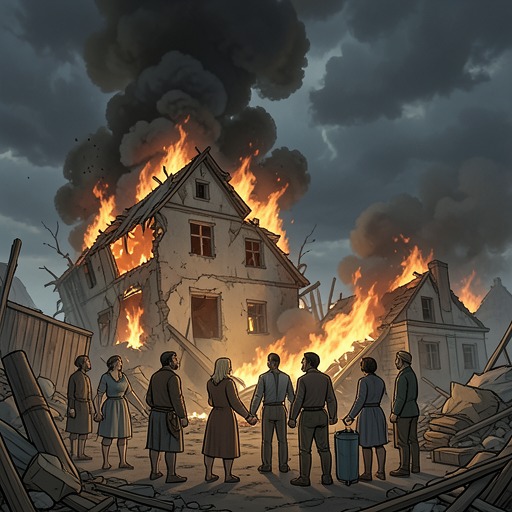
When the flames and wind overwhelm the area, the Upper Sugar Bushes is no longer associated with maple shipments or the prosperity of Williamsonville but with an advancing ecological disaster. Robert and Charles Williams struggle through heat, ash, and the smell of burnt hair and flesh while searching for shelter. Their route leads back toward the bay, the only refuge Robert can identify as the sky burns and fire seems to consume even the water’s surface. The forest’s economic presence thus reverses into mortal threat, transforming the landscape that feeds the settlement into the force driving its people toward survival.
Narrative Significance
Upper Sugar Bushes gives the surrounding catastrophe a material history. The fire is not an isolated supernatural or sensational incident detached from ordinary life; it emerges from a landscape altered by prolonged drought and connected to the settlement through timber extraction. The forest’s environmental damage reaches homes, lungs, work routines, and family plans, making the consequences of ecological risk intimate rather than remote.
Its significance also lies in the contrast between abundance and fragility. Millions of acres of trees suggest inexhaustible wealth, yet a single rainless summer leaves them more combustible than a desert. The maple shipment expected from the Upper Sugar Bushes represents continuity—the next load needed to keep the mill operating—at the same time that drifting embers announce how quickly that continuity can collapse. The location therefore stands at the center of the story’s tension between human industry and the unstable natural systems on which that industry depends.